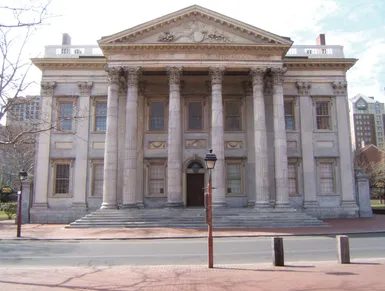
The image of the First Bank of the United States in Philadelphia still stands today. It is part of Independence National Historical Park now. But back then, it was the flashpoint for America’s first major fight over money.
What is a national bank? In the U.S., it is a commercial bank. It is chartered and supervised by the federal government. But it is owned and operated by private individuals. This distinction matters because it created a unique hybrid that shaped the modern financial system.
The Early Experiments
The first two attempts at a central bank failed. The First Bank of the United States ran from 1791 to 1811. The Second Bank of the United States lasted from 1816 to 1836. Both acted as agents for the U.S. Treasury. They competed with state and private banks. This competition forced those private banks to redeem their own banknotes at full value. It kept the currency somewhat stable.
But stability bred resentment. President Andrew Jackson hated the Second Bank. He viewed it as a monopoly that favored the elite. His political power killed the bank’s charter in 1836. The result was chaos. Without a central regulator, state banks printed money willy-nilly. This era of “free banking” lasted until the Civil War.
The Civil War Catalyst
The war exposed the flaws. The U.S. needed to finance a massive conflict. The old system could not handle the strain. There was no sound currency. No reliable way to raise capital quickly. The difficulties pointed to one conclusion: the country needed a better banking system.
Congress acted in 1863. They passed the National Bank Act. This law created a new system of federally chartered banks. These national banks would circulate a stable, uniform currency. The money was secured by federal bonds. Each bank had to deposit these bonds with the comptroller of the currency. He was the national banking administrator.
How It Worked
The 1863 Act set strict rules. It defined minimum capital requirements. It limited the kinds of loans banks could make. It mandated reserves against notes and deposits. It also set up supervision and examination of banks. The goal was to protect noteholders. If a bank failed, there was a safety net.
The Act did not ban state banks from issuing their own currency. That would have been too blunt an instrument. Instead, Congress used a tax. They imposed a 10 percent tax on state banknotes. The math was simple. It was cheaper to issue national banknotes than to pay the tax. The state banknotes were effectively eliminated. A rival currency disappeared overnight.
The Inflexibility Problem
There was a flaw. The supply of national banknotes was inflexible. It was tied to the amount of federal bonds banks held. If the bonds were scarce, the money supply shrank. Banks also lacked sufficient reserves. This rigidity caused panic. It led to financial crises in 1873, 1893, and 1907.
The fix came in 1913. The Federal Reserve System was formed to provide elasticity. It could expand or contract the money supply as needed. By 1935, the national banks had transferred their note-issuing powers to the Fed. They stopped printing their own paper money entirely.
National Banks Today
What are national banks now? They are primarily commercial institutions. Some still hold savings and trust functions. But they do not issue currency. The Federal Reserve handles that.
Regulation is shared. The Office of the Comptroller of the Currency (OCC) charters, regulates, and supervises national banks. The Federal Reserve shares supervisory authority with them. This split