The house was gone. Not just the walls, not just the roof, but ten years of blood, sweat, and roots in Altadena. For Sylvie Andrews and her partner, the Eaton Fire wasn’t a data point. It was a lifetime erased in January 2026.
“We put a lot into it,” Andrews said. “That’s what we lost.”
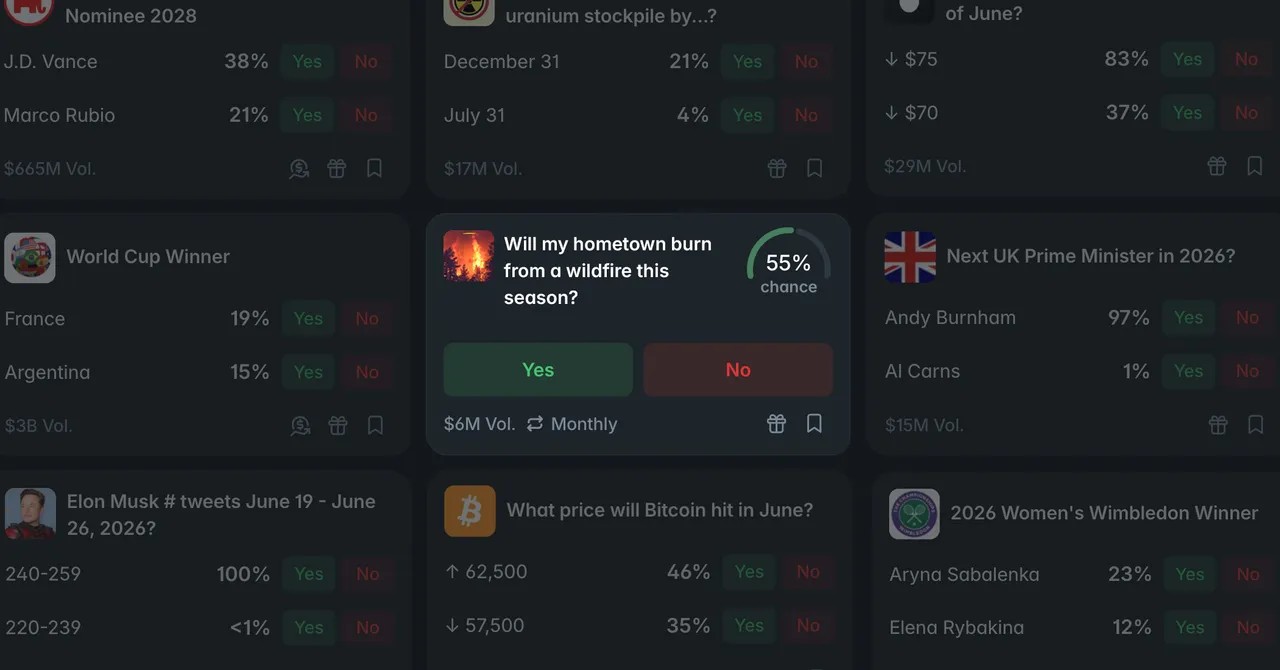
While survivors packed cars to outrun flames, other people clicked buttons. They logged into Polymarket, the giant in prediction gambling, to wager on how far those flames would spread. Would they hit Santa Monica? When would containment start? These weren’t academic questions to these users. They were opportunities.
Prediction markets turn life-or-death scenarios into simple yes-or-no bets. The price of a contract hovers between $0 and $1. Pay fifty cents for “yes”? That means the crowd thinks there’s a 50/50 shot it happens. It’s gambling. Plain and simple. Hosts take a cut. Everyone else plays with risk.
In 2024, Southern California burned. Over 16,00 structures burned to the ground. 31 people died. Yet almost twenty different questions appeared on Polymarket about the fire behavior. By the time the smoke cleared, roughly $1.2 million had changed hands on these queries.
And how did the survivors feel?
“Wow,” Andrews repeated. “It’s morally reprehensible.”
Susan Sherman, who grew up in Palisades and watched her parents’ century-old home vanish in the Palisades Fire, felt a similar chill. To her, treating trauma as a stock portfolio felt hollow. Cruel. She calls the practice heartless.
And why shouldn’t we be nervous?
Fire isn’t a hurricane. It isn’t a flood that just happens because of rain patterns. Fire is manipulatable. It only takes one person with a lighter to change the outcome. This creates a dangerous perverse incentive. Why start a small brush fire if you’ve already bought “yes” contracts on massive containment delays?
Ann Skeet, an ethics director at Santa Clara University, puts it bluntly. A market that could theoretically encourage arson is a dangerous market. It also opens the door for insider trading. If you work for the fire service and know containment is delayed, you might bet accordingly. That’s corruption. But mostly, Skeet argues, it cheapens human life.
“When you start gambling on someone’s potential death… you are diminishing the value you place on that life.”
This isn’t just old news. The market is growing. Wyldfyre launched recently, a platform dedicated solely to California wildfires. Their slogan is chilling in its pragmatism: “You can’t predict wildfire. You can trade on it.”
The site is opaque. No owner listed. No contact info. Right now, users only simulate trades, but real-money betting is promised soon. Wyldfyre claims to use collective intelligence to help forecasters. They say they turn bets into public goods.
The people actually fighting fires disagree. Hard.
The US Forest Service has no interest in this data. Their spokesperson told High Country News that their mission protects lives and lands, not financial speculation. They rely on science, physics-based models, and data from the National Weather Service. Not crowdsourced guesses from gamblers.
California’s Cal Fire holds the same line. Staff Chief Phillip SeLegue explained that their fire-behavior modeling uses weather, fuel loads, topography, and physics.
“It is not informed by markets,” SeLegue said.
Politics is catching up, slowly. Reps from Utah and California introduced legislation in March to ban betting on terrorism or assassinations. Another senator wanted to ban bets on specific deaths. Minnesota outlawed hosting prediction markets, prompting a federal lawsuit. Wildfire betting? Not yet explicitly banned. Not yet protected.
So where does that leave people like Andrews? She doesn’t expect the courts to fix this morality issue quickly. Instead, she looks at the winners. The people who guessed right while her town burned.
“I would hope that they might be ashamed,” she says. “And take that money… and donate it directly to survivors.”
It’s a thin hope. But it’s what she has. The fires keep burning. The markets keep trading. And the distance between a financial gain and a destroyed home grows wider by the acre. 🕯️