Black holes don’t run out of fuel. Not even when they are actively blasting it away.
It’s a paradox that has stuck with astrophysicists for years. Nearly every large galaxy hosts a supermassive black hole in its core. These monsters weigh millions to billions of suns. They grow by eating matter. But that eating process generates immense energy jets.
These jets heat the surrounding gas. Hot gas doesn’t collapse. It doesn’t form stars. It stays diffuse. So, the black hole’s own output disperses its food supply. If the fuel blows away, the engine should stall.
It doesn’t. Why?
New research from the University of Montreal and an international team suggests the answer is simpler than we thought. It’s a cycle. A loop. A cosmic recycling system.
Seeing the Unseeable in NGC 4696
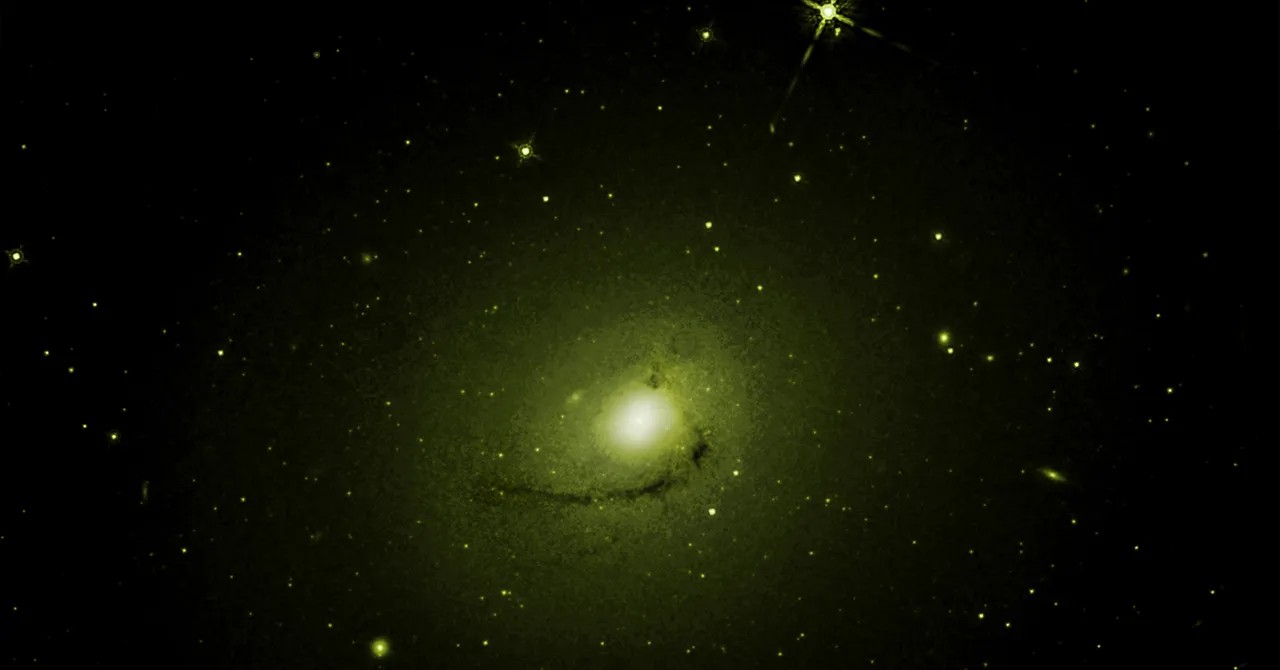
The team looked at NGC 4696. It sits in the Centaurus Cluster, roughly 145 million light-years away. This galaxy isn’t new to us. Past observations had already hinted at an S-shaped spiral of gas wrapping around its central black hole. But details were fuzzy.
To get a closer look, the researchers pointed the James Webb Space Telescope’s (JWST) Near-Infrared Speleographer (NIRSpec) at the core. They spent about eight hours staring into the dark.
The results were sharp enough to resolve structures just 30 light-years wide. Think about that scale. If a galaxy were shrunk to the size of a soccer field (about 300,00 light-years compressed to 100 meters), JWST could spot a single marble placed on it from 50 kilometers away.
What they saw was a rotating disk. Not just any disk. One 800 light-years across. Gas here is being ripped around by the black hole’s gravity. It moves at several hundred kilometers per second. The speed difference between one edge and the other? About 600 kilometers per second.
But the disk isn’t isolated.
Filaments are flowing into it.
The Filament Highway
These threads of gas are the missing link.
When jets heat the galaxy, gas is pushed out. It expands into interstellar space. There, it cools. As it cools, it condenses. It forms thin, string-like filaments.
In NGC 4696, these filaments act as delivery trucks. They carry the cooled gas right to the edge of the rotating disk. The gas accumulates there. Then it gets pulled in. It becomes fuel for the black hole again.
For the first time, we are seeing the whole path. Heating. Cooling. Filament formation. Accretion. It is a closed loop.
“What JWST is revealing is that black holes may indeed be the ultimate cosmic recyclers.”
Julie Hlavacek-Larrondo led the study. Her team’s data shows the black hole isn’t just destroying its environment. It’s reshaping it into something that can feed back into itself. The black hole releases energy, heats the gas, but that same gas later cools into filaments that fall inward. The cycle sustains the growth.
Magnetic Ropes and Wobbling Axes
Observations are one thing. Physics is another. The team ran computer simulations to see how this actually works.
They found that magnetic fields play a huge role. As filamentary gas falls inward, stretched magnetic lines act like ropes. They exert torque. They remove angular momentum from the gas. Without that momentum to keep it spinning wildly, the gas can actually fall into the disk instead of scattering away.
This explains why the disk forms at all.
The simulations also showed the disk doesn’t stay still. It wobbles.
Why? Because filaments come from everywhere. They flow in from many different directions. This chaotic input makes the disk’s axis shift. The black hole’s energy jets follow. They shift too.
Instead of blasting in one direction and leaving a cold spot, the jets heat the central region more evenly. Uniform heating prevents large chunks of gas from cooling too quickly and falling in uncontrollably. It stabilizes the system. It keeps the feedback loop running.
Not Every Hole Is the Same
This specific recycling mechanism depends on balance. The jets are powerful, but not too powerful.
In other galaxy clusters, the black holes are more aggressive. Their jets are so energetic that no disk forms. The gas remains in a chaotic state, never settling into the filaments or the rotating structure seen in NGC 4696 here. Activity level dictates behavior. If the hole is too strong, it breaks the recycling system entirely.
This study is just the beginning. It’s the first of three papers. The current analysis focused on warm gas at 10,000Kelvin. Papers looking at different temperatures are still in the works.
The discovery has already triggered more JWST observations. Telescopes worldwide are lining up for coordinated views. Researchers want to know: Do other galaxies have this same self-sustaining engine?
We finally have the tools to check. And the black holes might be holding secrets we haven’t even begun to guess.