In a quiet office in Cambridge, Massachusetts, a robotic claw moves with an unexpected grace. It doesn’t just grab; it searches. When a light bulb rolls away from its grasp, the robot doesn’t freeze or fail. Instead, it chases the bulb across a table, nips it back into position, and carefully screws it into a socket to illuminate its workspace.
For decades, robotics has faced a frustrating paradox known as Moravec’s Paradox : high-level reasoning (like playing chess) is easy for computers, but low-level sensorimotor skills (like grasping a fragile object or tying a shoelace) are incredibly difficult. While AI has mastered language through models like ChatGPT, the physical world remains a chaotic, unpredictable challenge.
A startup called Eka is now attempting to bridge this gap, moving beyond “clumsy” automation toward true physical intelligence.
The “Sim-to-Real” Hurdle
To understand why Eka’s progress is significant, one must look at the history of robotic training. In 2018, OpenAI demonstrated “Dactyl,” a robotic hand that could solve a Rubik’s Cube. While impressive, it was a “brittle” success. The robot relied on perfect conditions and specialized sensors; if a cube slipped or the angle was slightly off, the system failed.
The industry has long struggled with the “sim-to-real gap” —the disconnect between a perfectly controlled digital simulation and the messy, gravity-bound reality of the physical world. Many researchers believed that training robots entirely in simulation was a dead end because virtual physics can never perfectly replicate the friction, weight, and unpredictability of real life.
A New Approach: Vision-Force-Action
While many companies are trying to teach robots by showing them videos of humans performing tasks (a method known as Vision-Language-Action models), Eka is taking a different path. Rather than imitating humans, they are letting robots learn for themselves through massive-scale simulation.
Co-founders Pulkit Agrawal (an MIT professor) and Tuomas Haarnoja (a former Google DeepMind researcher) have developed a proprietary approach:
- Self-Taught Intelligence: Similar to how Google’s AlphaZero learned chess by playing against itself, Eka’s robots spend thousands of hours in simulated environments, inventing their own strategies for movement.
- Vision-Force-Action Models: Unlike older models that only “see” pixels, Eka’s algorithms incorporate the principles of physics. The robot understands mass, inertia, and—crucially—force.
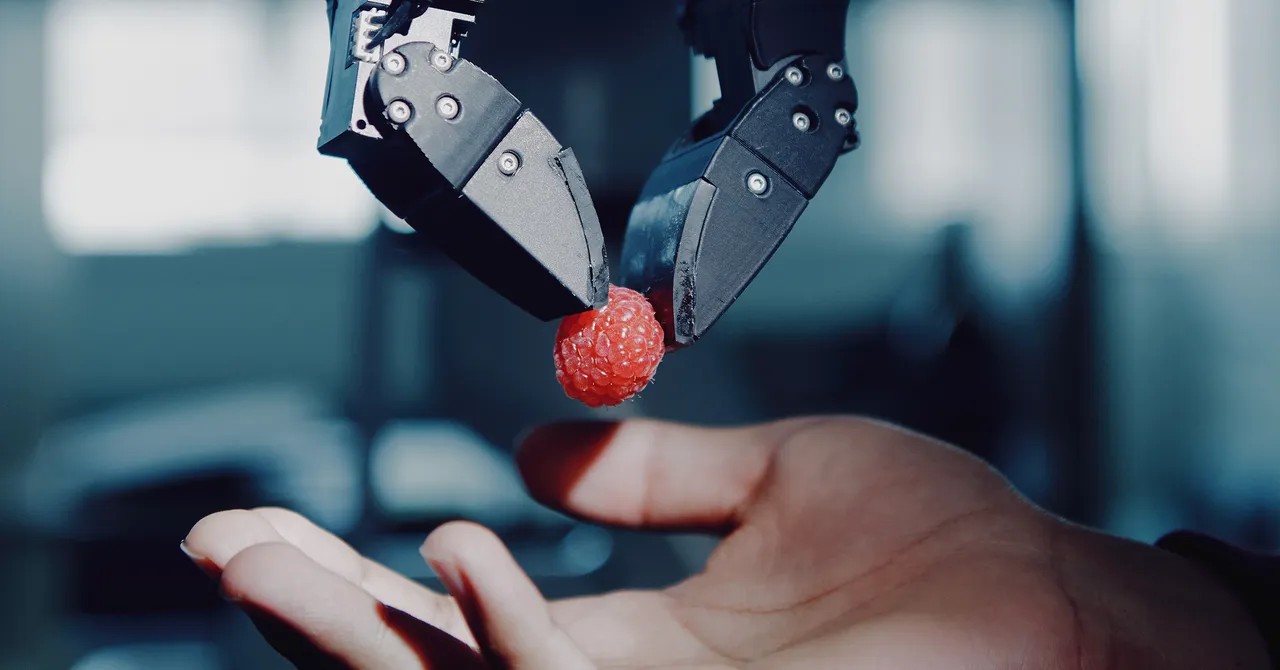
- Tactile Feedback: Eka has developed custom grippers that provide a sense of touch, allowing the robot to feel the weight of an object or the resistance of a surface.
From Chicken Nuggets to Global Industry
The practical implications of this technology are vast. In a recent demonstration, the robot handled a task as seemingly mundane as sorting chicken nuggets from a conveyor belt into containers. The robot showed “human-like” improvisation, occasionally tossing nuggets into a container if it was moving out of reach—a level of fluid decision-making rarely seen in traditional robotics.
This capability is particularly vital for industries that have remained stubbornly human-dependent:
* Food Service: Handling irregular, delicate items like fruits, vegetables, and meats.
* Manufacturing: Performing “fiddly” assembly tasks, such as building electronics.
* Logistics & Retail: Navigating shops and warehouses where objects are not always in predictable positions.
The Path Ahead
We are currently in the “GPT-1 era” of robotics. Just as early language models were often incoherent before they became conversational geniuses, Eka’s robots are showing the first glimmers of embodied intelligence. They are beginning to understand not just where an object is, but how it feels and how it moves.
Whether this simulation-heavy approach will ultimately surpass human-demonstration models remains to be seen. However, if Eka succeeds in closing the sim-to-real gap, the “trillions of dollars” currently flowing through human hands may soon be managed by machines with equal dexterity.
Conclusion: By prioritizing physical laws and tactile feedback over simple imitation, Eka is attempting to solve the hardest problem in robotics: giving machines the ability to navigate and manipulate the unpredictable physical world with human-like grace.