


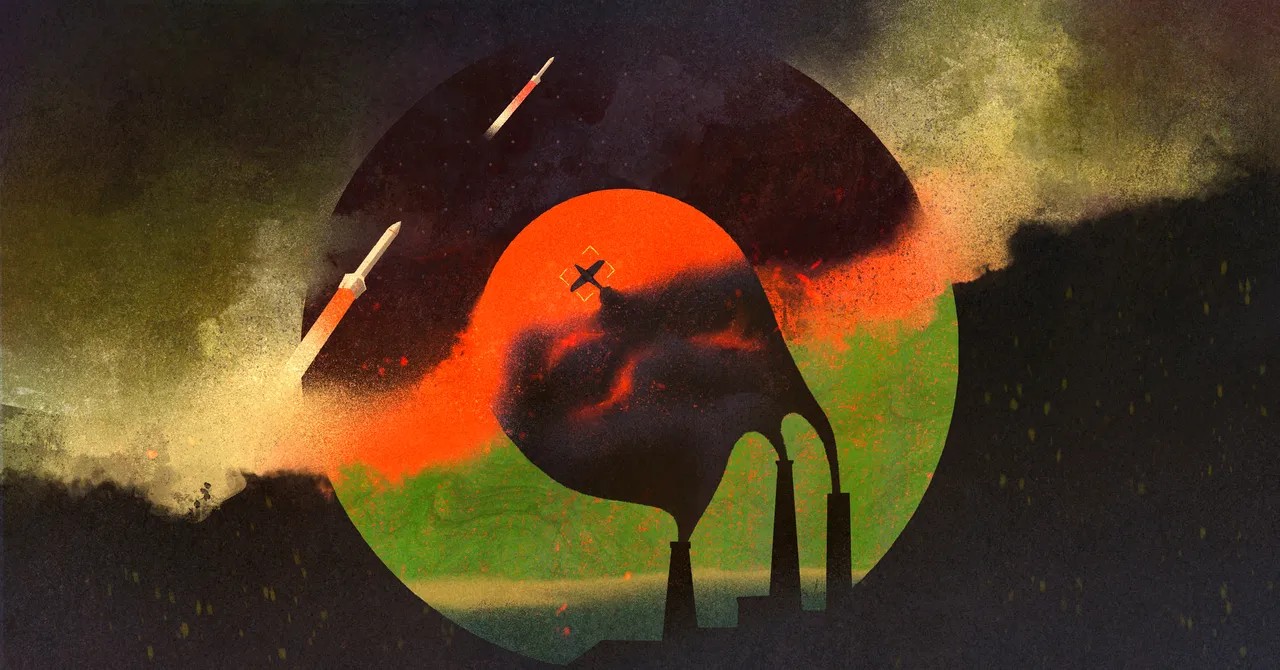
While the headlines focus on troop movements and strategic strikes, a secondary, more insidious war is being waged against the region’s ecosystem. From the “black rain” falling over Tehran to the oil slicks threatening the Persian Gulf, the environmental toll of the conflict is mounting across land, sea, and air.
This is not merely a side effect of combat; it is a systemic ecological assault that threatens food security, water safety, and long-term climate goals.
☁️ The Air: Toxic Skies and Carbon Bursts
The most immediate and visible impact has been the degradation of air quality. Following strikes on Iranian oil facilities, the skies over Tehran were reportedly engulfed in thick, noxious black smoke.
The environmental consequences of these atmospheric changes are twofold:
– Immediate Health Risks: The release of black carbon, sulfur oxides, and nitrogen oxides poses acute respiratory threats to millions of residents.
– Climate Impact: Modern warfare is a massive carbon driver. Researchers estimate that just the first two weeks of hostilities released over 5 million tons of CO2 equivalent.
– A single missile strike carries the carbon footprint of driving a car for 350 miles.
– A single fighter jet emits approximately 15 tons of CO2 per hour of flight.
🏗️ The Land: The Toxic Legacy of Rubble
On the ground, the destruction of infrastructure creates a “slow-motion” disaster. In Lebanon, the scale of debris is staggering; experts note that the country generated more rubble in three months than it typically would in 20 years of peacetime.
The danger lies in what this debris contains. When buildings are pulverized, they release a cocktail of pollutants into the soil, including:
– Heavy metals and asbestos
– Plastics and solvents
– “Forever chemicals” (PFAS) from military hardware
“Once a bomb goes off, the smoke dissipates, but the debris stays. It can mix into the soil and water, changing their very quality,” warns Antoine Kallab, a policy adviser studying Lebanon’s environmental damage.
This contamination leads to bioaccumulation : toxins enter the soil, are absorbed by plants, eaten by animals, and eventually move up the food chain to humans. In Lebanon, at least 68% of agricultural areas have already been impacted by the conflict.
🌊 The Sea: Fragile Ecosystems Under Siege
The Persian Gulf is a uniquely vulnerable marine environment. It is shallow, warm, and semi-enclosed, meaning pollutants do not easily flush out to the open ocean.
Recent maritime incidents have heightened fears for regional biodiversity:
– Oil Spills: The grounding of the Shahid Bagheri —a vessel converted for military use—led to heavy fuel oil leaks drifting toward the Hara Biosphere Reserve, a UNESCO-protected site.
– Threatened Species: The region is a critical habitat for rare species, including fewer than 100 Arabian humpback whales and thousands of dugongs, which cannot simply migrate away from localized chemical spills or sonar disruptions.
– Water Security: For Gulf states that rely heavily on desalination, any significant maritime contamination poses a direct threat to the primary source of freshwater for their populations.
📉 The Aftermath: A “Death by a Thousand Cuts”
The true danger of environmental warfare is its persistence. Even when the bombs stop falling, the ecological recovery faces two massive hurdles:
- The Reconstruction Paradox: The very act of rebuilding destroyed cities—replacing concrete, roads, and utilities—releases massive amounts of carbon, often offsetting any progress made in climate mitigation.
- Governance Collapse: As nations struggle to rebuild homes and restore livelihoods, environmental protection is almost always deprioritized.
“It’s not about a single instance,” says Doug Weir of the Conflict and Environment Observatory. “It’s about the kind of death by a thousand cuts.”
Conclusion: The environmental impact of this conflict is a cumulative crisis of pollution, carbon emissions, and toxic debris that will persist long after political hostilities cease, potentially crippling the region’s ability to sustain its people and ecosystems for decades.


