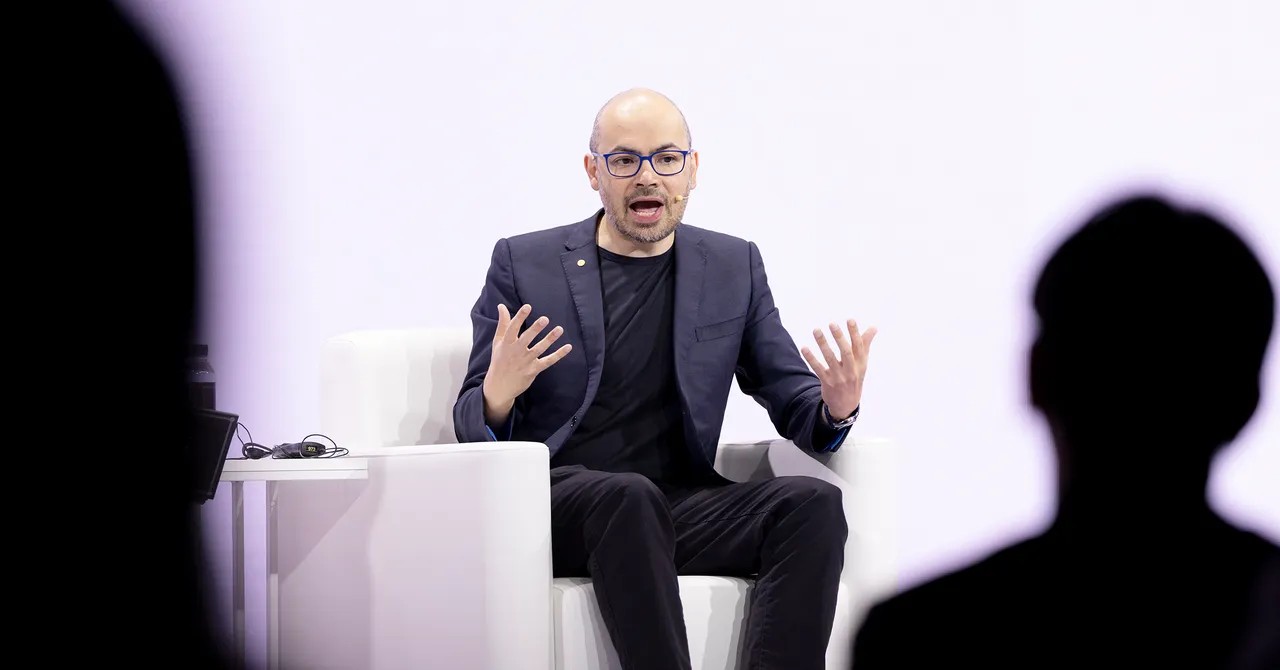
Demis Hassabis wants you to talk about code. Not the panic. The code. Specifically, what his team at Google DeepMind cooked up with the new Gemini 3.5 Flash model. It writes operating systems from scratch. It translates massive codebases across languages. It finds bugs hidden in knotty logic like a bloodhound.
Yet the CEO insists this isn’t the end of the developer job.
He’s bored of the doomsday tweets.
“I have no idea why people go around talking with such certainty.”
That’s his take, shared with WIRED ahead of Google’s I/O event today. He suspects ulterior motives for the fear-mongering. Maybe raising capital? Who knows. But his view is simple. If AI makes engineers four times as productive, Google isn’t going to fire three quarters of its staff. It’s going to do four times the work.
The world outside Google headquarters doesn’t seem to share that calm.
Fear is rampant. People worry white-collar coding gigs are on the chopping block. Big tech executives at Amazon, Salesforce, and Block have already pointed to AI as a reason for recent layoffs. Other AI founders have explicitly predicted mass displacement. It’s a lucrative narrative, sure, but Hassabis sees it as lazy.
“It’s a lack of imagination,” he says, “and a lack of understanding.”
Hassabis runs Alphabet, not just Google. He has ideas everywhere. Lab drug discovery. Game design. Complex simulations. He needs people to execute those visions. Not fewer people. More productive ones.
The Catch-Up
Google is behind in AI coding. No sugarcoating that.
A 2025 Stack Overflow Survey shows developers prefer Claude by Anthropic and Codex by OpenAI. They are the current kings of adoption. Google had to act.
At the event, they showed off “Antigravity.” It uses the new Gemini 3.5 Flip to handle frontier-level reasoning. The pitch is speed plus cost. Cheaper than rivals. Faster, too. They are also dropping a beefier model called Gemini 3.5 Pro next month.
But the tools are just half the story.
Agents With Leashes
Google also demoed “Spark.” It’s an agentic assistant living in the cloud. It can touch apps and get things done. But it’s designed with guardrails. Less access to your private data than something wilder like OpenClaw. Safety first.
Then there were other demos. An Android phone with a built-in agent. A revamped Google Search that doesn’t just list links. It writes apps or sites on the fly while you search.
Is it superhuman intelligence yet? No.
Hassabis doubts self-improving loops—AI rewriting its own code for betterment—will instantly yield god-like systems. Other scientific breakthroughs need physical understanding. The ability to run actual experiments. Things AI currently struggles to grasp.
Even in coding, a “solved” domain by all accounts, AI hasn’t built a hit game. No blockbuster app exists that wasn’t steered by a human hand.
“I think there’s something missing.”
Hassabis doesn’t name the gap. He just knows it’s there.
The fear of job losses persists because the gap feels small to outsiders. It doesn’t feel small to the builders. They know the code writes itself, but the vision—the actual “what” and “why”—still comes from a person in a chair. Or does it?