


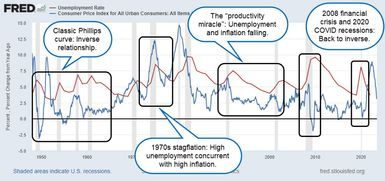
The relationship between the number of unemployed and the rate of increase in prices is not as simple as the textbooks once claimed. For decades, economists have relied on a visual model called the Phillips curve to explain this dynamic. Here’s a simple compromise. If we want to reduce unemployment, we have to accept higher inflation. If we want price stability, we may have to put up with more unemployment.
But the beautiful inverse relationship between unemployment and inflation has broken down. Named after economist William Phillips, the theory is based on data showing that wages rise faster when jobs are scarce. The logic is simple. When unemployment is low, companies compete for talent by offering higher wages. High unemployment reduces workers’ influence and slows down wage growth. Wages are a big cost for businesses, so higher wages often lead to higher prices.
This mechanism means that policy makers cannot have their cake and eat it too. In the long term, it is not possible to maintain low unemployment and low inflation at the same time. Eventually, one pushes the other up.
The origin of the theory
Phillips published his findings in a 1958 paper entitled “The Relation between Unemployment and the Rate of Change of Wages in Britain 1861-1957”. He analyzed almost a century of British data. He found a consistent pattern. Changes in wage levels are often explained by the unemployment rate.
There is one exception. This pattern breaks when the prices of imported goods suddenly rise. In most cases, however, the data is retained. Low unemployment means wages are growing fast. High unemployment means slow wage growth. This became the basis of macroeconomic thinking. This shows that managing the economy means managing unemployment to achieve the inflation target.
Why the model failed
This theory faced its first major crisis in the 1970s. The United States experienced stagflation. This is what the Phillips curve cannot explain. Inflation is high. The unemployment rate is also high. The inverse relationship no longer exists. If this theory holds true, high unemployment should weigh on inflation. But this is not the case.
The disconnect deepened in the early 2000s. The U.S. saw persistent low unemployment and inflation is relatively low. The model was again unable to predict the result. It turns out that the simple relationship between the unemployment rate and rising prices is not stable.
Several factors complicate this relationship. Regardless of the labor market, supply shocks increase costs. Inflation expectations also have an effect. If companies expect prices to rise, they may preemptively raise wages and prices, breaking historical ties. Technological advancement adds new layers. Former Federal Reserve Chairman Alan Greenspan spoke of the “productivity miracle” of the late 1990s. Productivity growth enables the economy to grow without triggering wage-push inflation.
Some economists, especially those of the Austrian school, believe that this theory was flawed from the start. They argue that it is based on mathematical models that ignore fundamental market forces. They point to the 1970s as proof that the Phillips Curve was not a reliable policy guide.
What this means for your financial decisions
The Phillips Curve makes intuitive sense when viewed in isolation. The demand and supply of labor changes with the cyclical fluctuations of the economy. Pricing power moves between employers and employees. In theory, this should cause prices to rise.
The real world is trickier. Employment and inflation are affected by many factors. Supply chains, technology, global trade and consumer psychology interact. A correlation between the unemployment rate and inflation observed in historical data does not necessarily mean that a causal relationship exists. It cannot remain stable for long periods of time or in different economic structures.
this matters for investors and financial planners. Relying solely on trade-offs between employment and prices can lead to asset mispricing. If you believe that low unemployment inevitably leads to high inflation, you may be over-hedging against rising prices in a productivity-driven economy. On the other hand, if you believe that inflation will naturally decline as employment recovers, you can ignore lingering price pressures.
The lesson is not that the data is useless. the mechanism is not rigid. Wage growth, inflation and unemployment are related, but this relationship is mediated by supply, technology and expectations. Understanding these nuances is important to navigating a market that rarely follows a straight line.
This curve is still in the textbooks. It can still be seen in central bank discussions. However, its predictive power has its limits. The economy does not obey simple formulas. It responds to a complex mix of forces that change over time. Ignoring this complexity is a risk no serious financial decision-maker can afford for financial decision makers.