


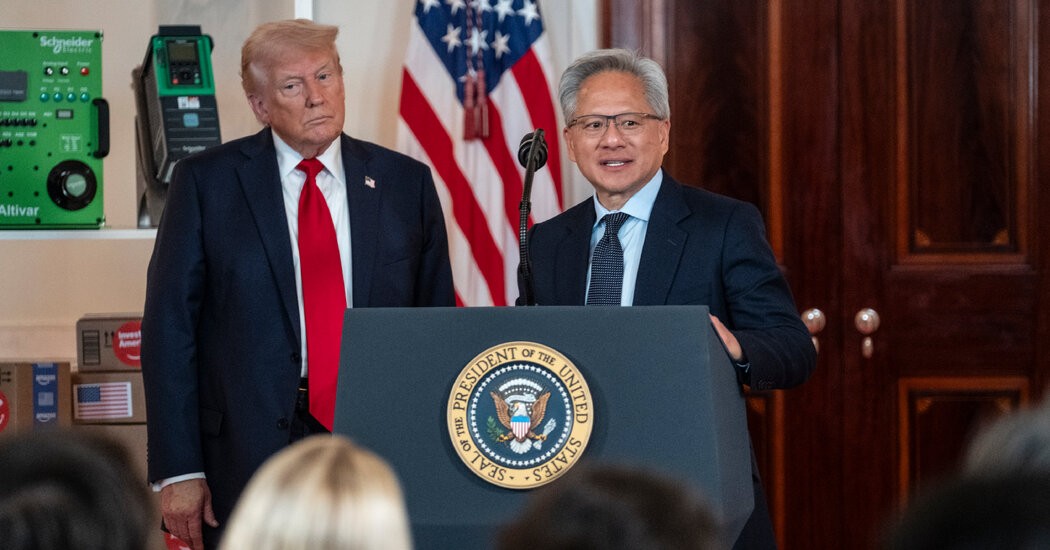
The unlikely partnership between former President Donald Trump and Nvidia CEO Jensen Huang has emerged as a significant force in international relations and technology policy. At a recent summit in South Korea, Trump paused his speech to inquire about Huang, calling him an “incredible guy” and speculating on his presence at the event.
Huang reciprocated the sentiment, praising Trump’s administration for deregulation that fueled artificial intelligence investment, claiming the former president had “completely changed the game.” He then expedited travel plans to join Trump in South Korea, highlighting a growing rapport between the two figures.
The Rise of Nvidia and Trump’s Recognition
Nvidia, a dominant player in AI chip manufacturing, has been among the first U.S. tech firms to follow through on commitments to bring production back to American soil. This move has not gone unnoticed by Trump, who closely monitors market performance – particularly Nvidia’s ascent as the world’s most valuable publicly traded company.
The strategic value of Nvidia’s chips extends beyond market capitalization. The company’s technology has become a key bargaining chip for the U.S. in negotiations with countries like Saudi Arabia, Britain, and China. Notably, Nvidia’s hardware has even played an undisclosed role in the administration’s diplomatic efforts to mediate conflicts between nations.
Implications for Geopolitics and Tech Policy
This alliance signals a shift in how technology intersects with global power dynamics. The Trump-Huang relationship leverages Nvidia’s market dominance and technological importance to advance U.S. geopolitical interests. This pairing reflects a broader trend of tech leaders aligning with political figures to influence policy and secure advantages in a rapidly changing world.
The mutual benefits are clear: Nvidia gains favorable regulatory conditions and political support, while Trump leverages Nvidia’s influence to strengthen U.S. leverage on the international stage. This partnership raises questions about the future of tech policy and the potential for further entanglement between corporate interests and national agendas.
In conclusion, the alliance between Trump and Huang is not just a business deal but a strategic alignment that reshapes the landscape of technology, geopolitics, and global influence.


